A paper-flower keepsake, a confirmation certificate, and one surname
Two objects out of the same pile. Separately they are pretty old paper. Together they are a family, a church, and a date you can check.
What it is
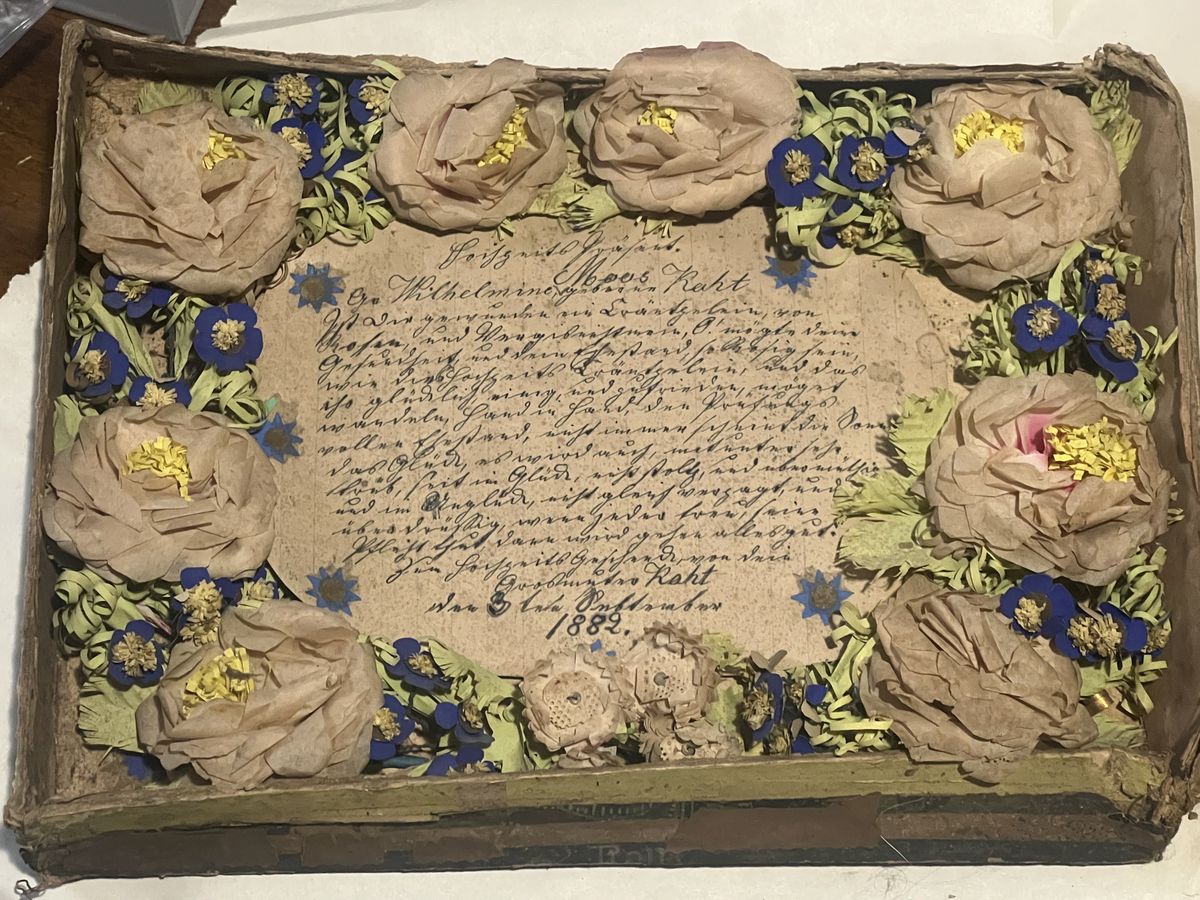
A shallow box, roughly the size of a large book, holding a single handwritten sheet. Around the writing, someone has built a full wreath out of handmade paper: tan roses with yellow paper centres, small blue flowers, green paper leaves and curled ribbon. It is all paper. None of it is fabric, and none of it was bought finished.
The writing is German, in the old Kurrent hand that anyone raised in nineteenth-century Germany would have written and almost nobody can read on sight today. That is the first thing worth knowing about objects like this: the barrier is the handwriting, not the language. Plenty of people who speak German cannot read this script.
What the sheet actually says
Enough of it is legible to place the object exactly.
- It is headed as a wedding piece, a Hochzeits poem.
- It is addressed to Wilhelmine, née Kaht, with the married surname written as Maas.
- It closes as a wedding gift from Grandmother Kaht.
- It is dated 1882. The day and month are written out but are harder to read with confidence than the year.
So: a grandmother wrote a poem for her granddaughter's wedding, then spent what must have been many evenings building a paper garden around it. That is the object. Not a decoration that happens to have writing on it.
The second object
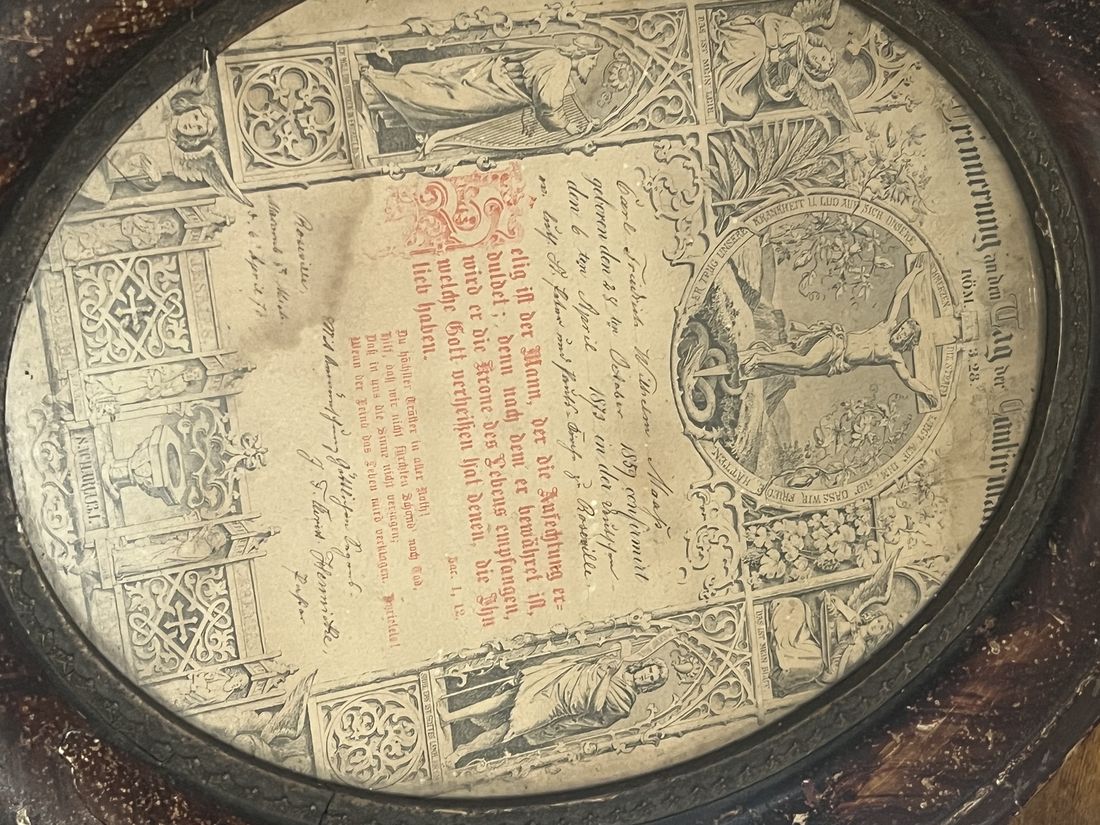
A German Lutheran confirmation certificate, printed as a lithograph and filled in by hand, still in an oval frame. The printed verse is James 1:12. The header reads as a remembrance of the day of confirmation.
The handwritten details are clear:
- Name: Carl Friedrich Wilhelm Maaß
- Born 28 October 1859
- Confirmed 6 April 1873
- At the Evangelical Lutheran St. Peter and Paul church, Roseville
The detail that connects them
Read carefully: that is a strong suggestion, not a proof. The two sheets share a surname and their dates fit together, and they came out of the same pile. It is entirely reasonable to think these are a husband's confirmation certificate and his wife's wedding gift, kept together for a hundred and forty years. It is not established until somebody checks a marriage record.
That distinction matters, and it is the whole habit this app is trying to build. A plausible story is not a verified one, and knowing which you are holding changes what you should pay.
Why Roseville is the interesting word
A German-language Lutheran confirmation certificate naming a church in Roseville is not a European object that drifted to America. It is an American object. Macomb County had substantial German settlement through the nineteenth century, and congregations there worshipped, taught and kept records in German for decades after arriving.
For a buyer this changes the whole frame. A generic nineteenth-century German certificate is a decorative item. A dated certificate naming a specific local congregation is a local history document, and local history has local buyers: historical societies, church archives, genealogy researchers, and families still in the area with that surname.
What this is worth
Honestly: as furniture, not much. Framed nineteenth-century certificates and paper ephemera are common, and condition here is what you would expect of paper that has been folded, framed and stored for well over a century.
But two things lift this above the pile, and both are things you can only see by reading the object rather than glancing at it. It is dated and named, which is the difference between "old German document" and a record about identifiable people. And it is local, which means there is a plausible buyer who wants it for what it says rather than how it looks.
The paper-flower work is genuinely uncommon. Handmade paper flowers survive far less often than the documents they decorate, because paper flowers get crushed. This set is largely intact.
None of that is an appraisal. It is the reasoning you would want before deciding what to offer.
What you would ask next
This is the part people skip. A first look gets you a guess; the follow-up questions get you an answer.
- Is the day and month on the 1882 sheet readable under better light, and does it match a marriage record for a Maas and a Kaht?
- Does St. Peter and Paul in Roseville, or a successor congregation, hold confirmation records for 1873?
- Is there anything written on the back of either sheet, or tucked behind the certificate in the frame?
- Are there more pieces from the same estate? Archives are worth more assembled than scattered, and splitting a family group to sell it piece by piece usually destroys the thing that made it valuable.
The lesson
The buy decision here was never really about resale. It was about recognising, in a pile of old paper, that two sheets were talking to each other.
Scan yours before you decide
What's It Worth? is free to try on iPhone and Android. Photograph the thing you cannot read, get a starting identification and recent sold comps, and keep asking it questions until the picture is clear.


More objects in Finds. How-to material in Guides.
Estimates are informational and not a certified appraisal.