
I have a weakness for thrift-store books that look as if they used to have a job. This one was green, thick, and built for somebody who had to look up a word in a hurry. I opened it expecting to find a year and maybe a price. What I found was Isaac Asimov.
I’d read I, Robot. I’d seen Fantastic Voyage. I knew the version of Asimov who could make me stay up late to find out which rule a robot thought it was following. I turned to the credits. There he was, at the top of a column under Consulting Editors, looking like he had every right to be there.
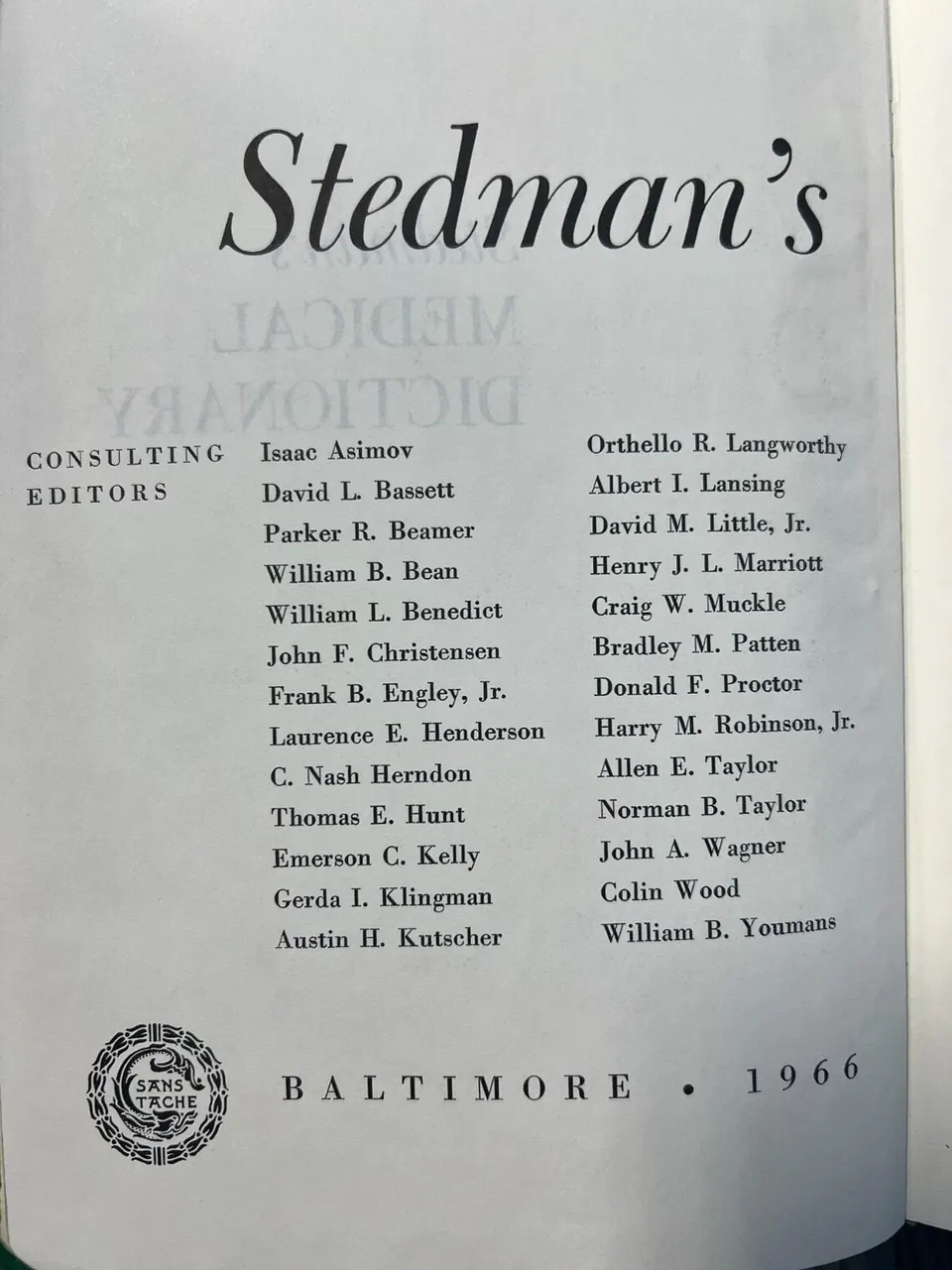
Why is Isaac Asimov in Stedman’s Medical Dictionary?
Stedman’s is roughly to medicine what Black’s Law Dictionary is to law. It defines terms and tells you how to pronounce them and where they come from. Asimov had a perfectly ordinary reason to belong in that room. He was a biochemist. Boston University hired him to teach biochemistry at its medical school in 1949. He was already on the faculty when I, Robot came out the next year. The dictionary records his consulting role alongside the other editors. Boston University timeline · Library record for the 21st edition
The submarine needed to wobble
The year the 21st edition appeared, 1966, Asimov also published his novelization of Fantastic Voyage. In it, a crew and its submarine are shrunk and injected into a man’s bloodstream to reach a clot in his brain. Asimov enjoyed the movie. He also thought the submarine sailed through blood with the composure of a ferry. At that tiny scale, molecules should buffet it in every direction. In his novel he gave it a little shake at the beginning. Then he got on with the voyage. Too much of the real thing, he wrote later, would have meant “bad sea-sickness for one thing.” 1966 novelization · Asimov’s 1969 essay, pp. 107–117
That was the rabbit hole I wanted. You can give this man a shrinking machine, a submarine, and a dying patient, and there will still be a moment when he stops to think about what the water is doing. The copyright page had given me the edition. The question I wanted to take into Dive Deeper was what the man who wrote all those stories about talking to machines knew about a trip through a blood vessel.
The second date in this copy
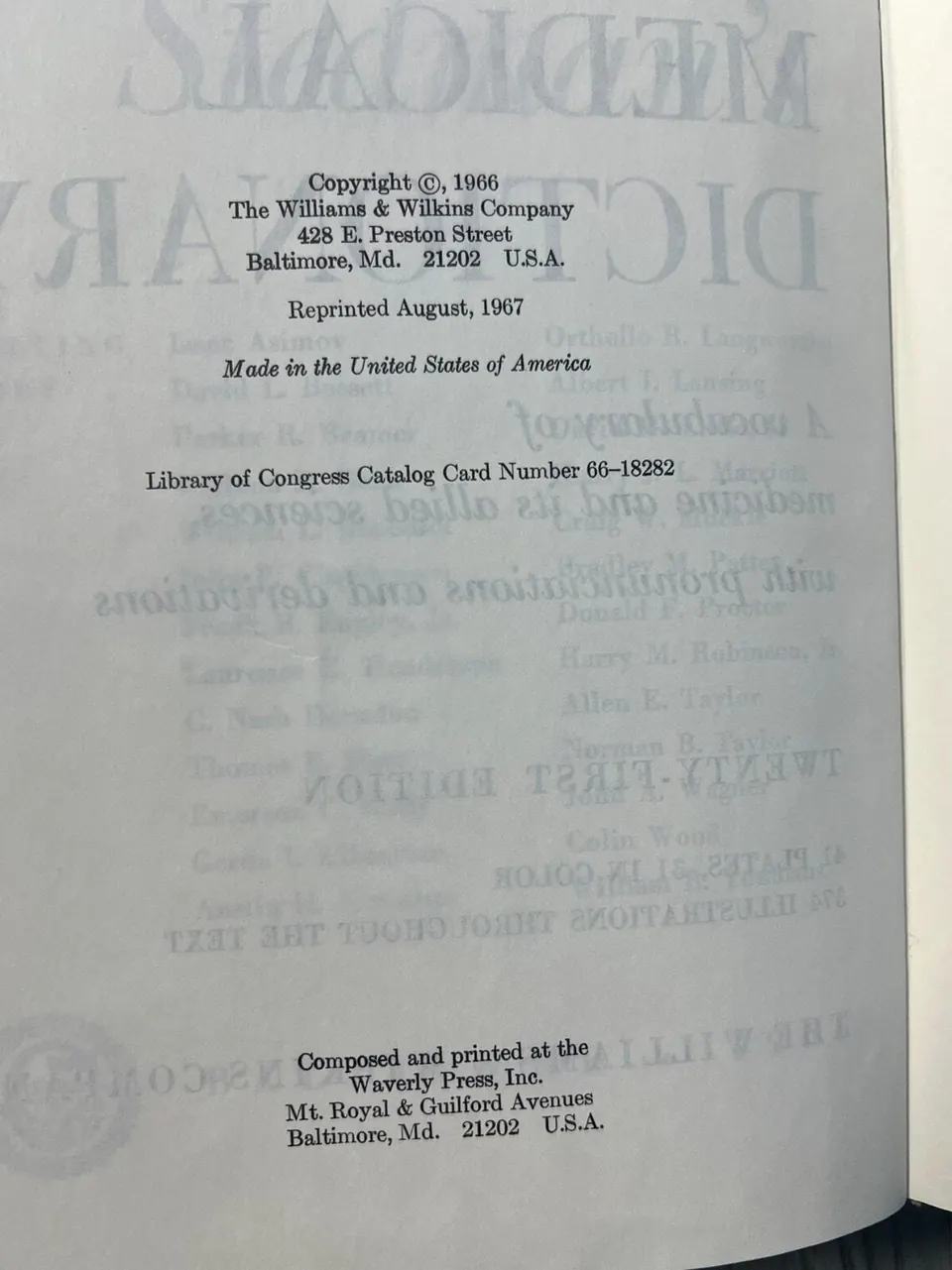
The credits page ends in Baltimore · 1966. Turn the title page over and you get a more specific answer about the book in hand. Williams & Wilkins published the 21st edition in 1966, and this copy says Reprinted August, 1967. If you’re comparing copies, scan both pages in What’s It Worth? and ask which date describes the edition and which describes the printing. A green cover will only get you so far.
I still couldn’t tell you who wrote the entry for seasickness. For the first time in my life, I wanted to look it up in a medical dictionary.
Another old book took me down a similar road, when a physician turned priest decided what the world needed was 552 pages of fish gossip.