
The print was supposed to go in the hallway. It went in the kitchen instead, because the hallway is where you walk past things, and I did not want to walk past this one.
A heavy black arc bends across the top, over a patch of green. There are two dark knots where I keep deciding the eyes are. On the right, a yellow shape pushes its nose into the dark. I keep switching between one face and two. It is a face that seems to have been interrupted in the middle of asking you something, and it has not decided whether to wait for your answer.
The listing put a name to it: Karel Appel. It described the framed print as a lithograph from XXe Siècle, Paris. I knew the name Appel the way you know the names of famous painters you have never looked up. I did not know why a face like this would make someone stop in a kitchen with a pan in their hand, so I went looking for the man who made it.
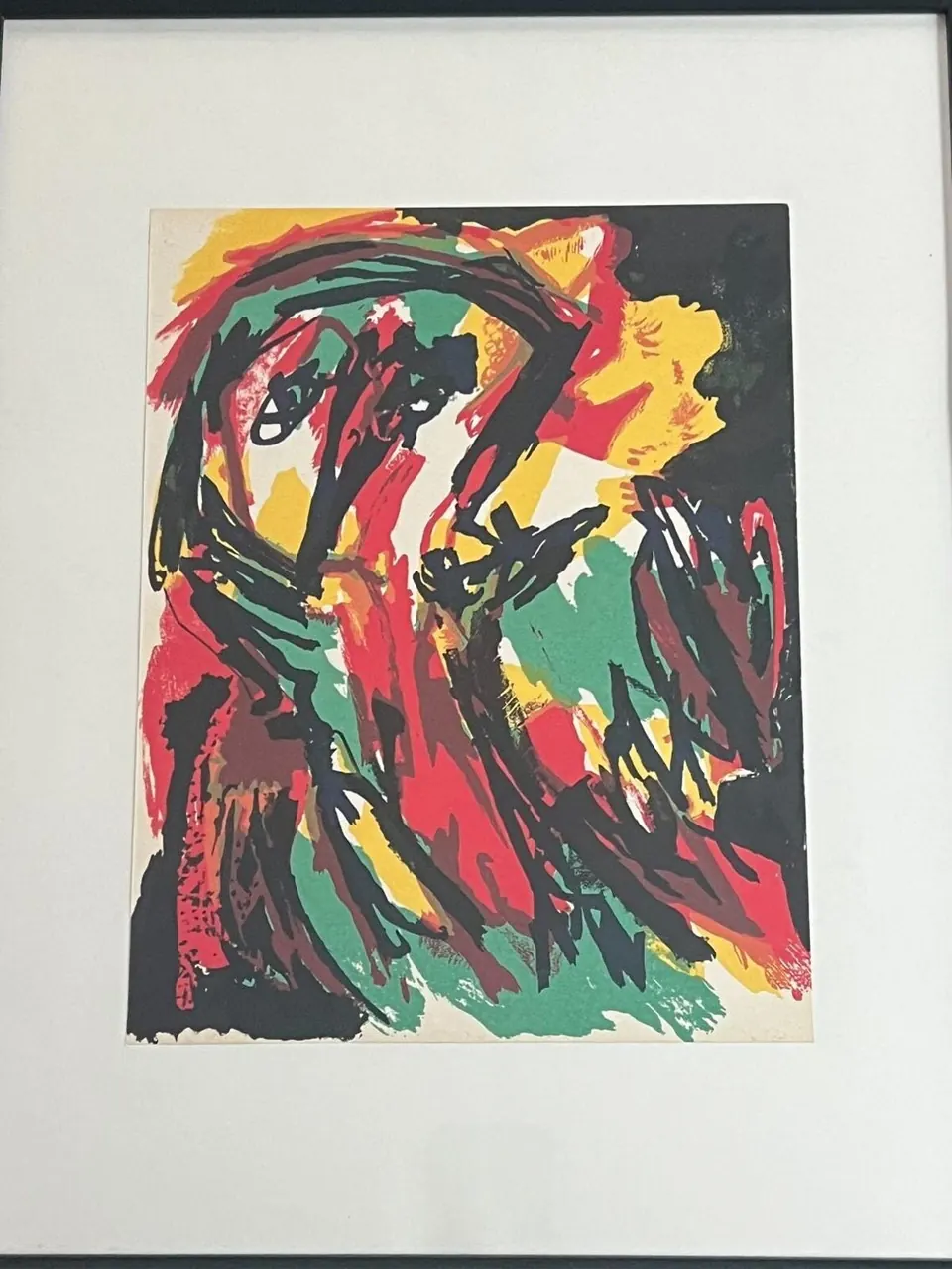
A Barbershop in Amsterdam
Karel Appel was born in Amsterdam in 1921. His father ran a barbershop on the ground floor of the family home. He trained at the Rijksakademie in Amsterdam from 1942 to 1944, during the German occupation, and being enrolled spared him from forced labor. In 1944 the police watched him on suspicion of sheltering people who were hiding from it.
That is the first thing worth knowing about the face in my kitchen. The man who painted it came of age in an occupied city, and came out the other side of a war that ended in the Netherlands with a famine winter. Whatever he decided painting was for after that, it was not going to be politeness.
Cobra
On 8 November 1948, in the Café Notre-Dame in Paris, Appel and five others founded the group that became Cobra: Christian Dotremont, Asger Jorn, Constant, Corneille and Joseph Noiret. The name, proposed by Dotremont, was built from the first letters of three cities: Copenhagen, Brussels, Amsterdam.
Their idea was to start over. Appel said they began again "like a child." Cobra painters looked hard at children's drawings, folk art and work by people with no training at all, because those were the pictures that had not learned what they were supposed to look like. They wanted loud, brash color and figures that arrived before the painter had finished thinking about them.
Which explains the face, a little. It is not unfinished. It is fast on purpose.
The Mural They Wallpapered Over
This is the part I kept coming back to.
In 1949 Appel painted a mural in the cafeteria of Amsterdam's city hall. He called it Vragende kinderen, usually translated as Questioning Children. The Dutch word vragen means to ask, and in the hungry years after the war, children asking had a very specific meaning. The faces are wide-eyed and grief-stricken, closer to a cry than a decoration.
The people who ate lunch under it hated it. After protests, the city covered it with wallpaper.
The architect Aldo van Eyck published a defense with the best pun in Dutch art history, Een appèl aan de verbeelding, "an appeal to the imagination." The Stedelijk Museum later gave Appel a commission to paint a foyer, now known as the Appelbar, as a kind of apology for what had happened in the city hall canteen. Appel himself moved to Paris, angry at how he had been treated. The building is a hotel now, The Grand.
Think about what actually happened in that room. Civil servants sat down to lunch every day under faces that seemed to want something from them. They could not eat with that wall looking at them, so they papered it over.
I understand the impulse. The face in my kitchen is from a different picture. I hung it there on purpose. That is the thing I found out about myself while reading about Appel: I like a picture that won't let lunch be entirely comfortable. Not cruel. Just awake. A face that asks you a question while you are buttering toast is doing exactly what Cobra wanted art to do, which is to refuse to be furniture.
Paris and XXe Siècle
Once Appel was in Paris, he was in the right city for prints. XXe Siècle was an art review founded in Paris in 1938 by Gualtieri di San Lazzaro. Its trick was to bind original prints into the issues, so a subscriber could own a lithograph by a living artist for the price of a magazine. Over the years those inserts came from a remarkable list of names, and Appel was among them.
That is where my print's story gets honestly uncertain. Appel lithographs turn up from more than one issue of XXe Siècle. An issue with its print still inside is the comparison I want. I could match the image and see what the issue actually says about the printing. A seller’s description gives me somewhere to start looking. The journal printer’s archive
The listing gives me a journal to look for. The issue is still a mystery.
What Would Settle It
I’d start a What’s It Worth? scan with the front, then bring the frame and any visible markings into Dive Deeper. The question I’d ask first is what kind of print I’m looking at. Which XXe Siècle issue matches this image? Is there a printer's credit anywhere on the sheet? Is there glue or a binding trace along one edge, the way a sheet pulled from a bound magazine often has? Does the back carry text from the issue, or is it blank? How big is the sheet, and is the mat hiding the edges that would tell me?
Those answers come from the object, not from the front of it. The image is what made me hang it in the kitchen. The back of the frame, the edges of the sheet and the printer's line are what will tell me which issue, which year and which press.
In the meantime, it is still looking at me. It still has not asked its question out loud. I have started to suspect that is the point.
Sources and Notes
- Object evidence: the framed print and the listing attributing it to Karel Appel and XXe Siècle, Paris. Issue, edition and printer are open questions.
- Karel Appel Foundation, chronology: the founding of Cobra at the Café Notre-Dame on 8 November 1948 and its founders, the city hall cafeteria mural, the protests, the wallpaper, Aldo van Eyck's defense, and Appel's death in Zurich.
- Stedelijk Museum Amsterdam: the Appelbar foyer commission as compensation for the Vragende kinderen mural in the town hall canteen, now the Grand Hotel.
- The Art Story, Karel Appel: his father's barbershop, the Rijksakademie years under occupation, Cobra's interest in children's and untrained art, and his move to Paris after the mural.