
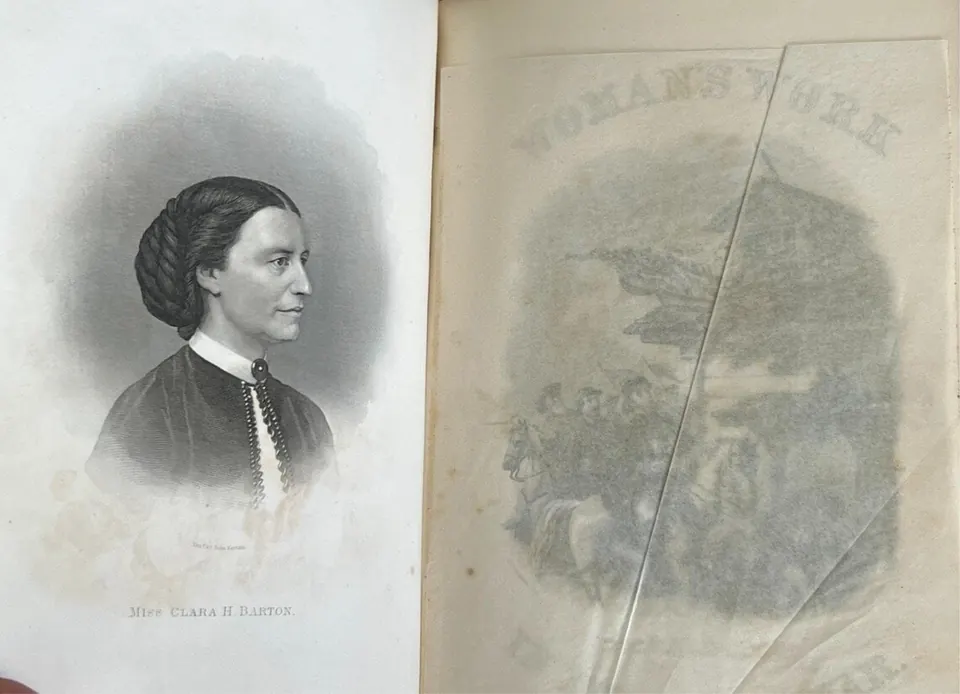
Woman's Work in the Civil War is the kind of book you open from the front and then start skipping around in. L. P. Brockett and Mary C. Vaughan first published it in Philadelphia in 1867, and the copy I was holding is from the next year: the title page says 1868. It promises sixteen steel engravings, and the women in those portraits are serious about having their portraits made. Clara Barton is first, in profile, opposite a sheet of tissue that still lies over the engraved title. After her come hundreds of pages of nurses, matrons, relief agents and organizers, chapter after chapter of women the authors wanted the country to remember.
I was skimming when I hit three pages that sounded different. The chapter on Cornelia Hancock begins with an apology.
"Of this lady's early history or her previous labors in the war," the authors wrote, "we have been unable to obtain any very satisfactory information."
Then they hand the floor to a man. Almost everything the book knows about her comes from John Vassar, an agent of the Christian Commission, who watched her work during Grant's campaign of 1864. She has no engraving. She gets pages 284 to 286. And the book says she was from Philadelphia, which turns out to be close, but not right.
I wanted to hear from her.
What the Book Knew
Vassar's account is worth reading closely, because it is a good one. Hancock was the first woman to reach Fredericksburg to help with the wounded in May 1864. The War Department had turned down requests from members of Congress to send her. So she signed on as a surgeon's assistant, since each surgeon was allowed one, and got on the boat that way.
By the time Vassar reached the Second Corps hospital, she was already there making soup and farina. When he opened a new hospital in a Methodist church the next morning, she had beef soup and coffee going for 120 men within an hour. She found herself a garret to sleep in, "and it was literally one." The winter before, the soldiers of the Second Corps had built her a house in their camp.
And there is this line, about the men who did not make it: "Were any dying, she sat by to soothe their last moments, to receive the dying message to friends at home, and when it was over to convey by letter the sad intelligence."
That is a tribute. It is also a man describing, from across the room, the hardest job in the building.
A Quaker from Hancock's Bridge
Cornelia Hancock grew up in Hancock's Bridge, a Quaker village in Salem County, New Jersey, across the Delaware from Philadelphia. Her sister's husband, Dr. Henry T. Child, was a volunteer surgeon. When the news of Gettysburg came, she set out with a party of volunteers headed for the battlefield.
On the way, they ran into Dorothea Dix, the superintendent of Army nurses. Dix had rules. She wanted nurses who were at least 30 and plain. Hancock was in her early twenties, and Dix turned her down. Every other woman in the group was accepted.
Hancock got on the train to Gettysburg anyway. She arrived on the night of July 6, 1863, three days after the battle. In her journal she later put the whole argument in one line: "the need was so great that there was no further cavil about age."
"Not Another Woman Within a Half Mile"
Her letters home start almost immediately, and they read nothing like a tribute. On July 7 she wrote to a cousin: "There are no words in the English language to express the sufferings I witnessed today." She was working in a field hospital with, as she put it, "not another woman within a half mile."
The letters are plain about the work. Four surgeons, she wrote, "none of whom were idle fifteen minutes at a time, were busy all day amputating legs and arms." She gave "every man that had a leg or arm off a gill of wine." She reported, a little proudly, that she did not mind blood and "was not sick at all." By August she had met the Army's paperwork, and wrote to her mother: "I do think military matters are enough to aggravate a saint."
Then, in one letter, she says this:
"I would get on first rate if they would not ask me to write to their wives."
That was where she came into the room for me. The book counted those letters among her good deeds, and they were. Here is the woman actually writing them, telling her family that amputations she could manage. It was the letters to wives that got to her.
It is the most human sentence I found about her, and it explains the apology at the start of her chapter. The authors of Woman's Work in the Civil War collected reports, testimonials and committee records. Hancock's own account of the war was in letters to her family, and those stayed private until the twentieth century. They were published first as South After Gettysburg and later as Letters of a Civil War Nurse.
After the Last Chapter
The book's chapter stops at City Point, Virginia, where she worked at the Depot Field Hospital during the siege of Petersburg. Her life kept going for another sixty years.
In 1866 she went to Mount Pleasant, South Carolina, and opened a school for freedpeople, with support from Philadelphia Quakers, and she taught there for close to ten years. Back in Philadelphia she helped found several charities, served on the board of the Children's Aid Society, and helped children orphaned by the Johnstown Flood. She was elected president of the National Association of Army Nurses of the Civil War. She retired to Atlantic City, New Jersey, and her ashes are buried in the Friends cemetery in the township where she was born.
When she died, there was a packet of letters beside her bed. It was marked "Burn without reading."
I like her more for that. The book that could not find her and the letters that finally let her speak are both on my shelf now, and somewhere there was a third set she decided was nobody's business.
Reading This Copy
The title page of this copy reads Zeigler, McCurdy & Co., with offices in Philadelphia, Chicago, Cincinnati and St. Louis, and R. H. Curran at 48 Winter Street in Boston, and it is dated 1868. Turn it over and the copyright is older: "Entered according to Act of Congress, in the year 1867, by L. P. Brockett," in the clerk's office for the Eastern District of New York. Below that are the printers, King & Baird of 607 Sansom Street, Philadelphia, and the stereotypers, Westcott & Thomson. That fits a book set in type in 1867 and printed again with a new date on the title page. Copies dated 1867 and 1868 both turn up, which is why the date on the title page matters more than the date in a description.
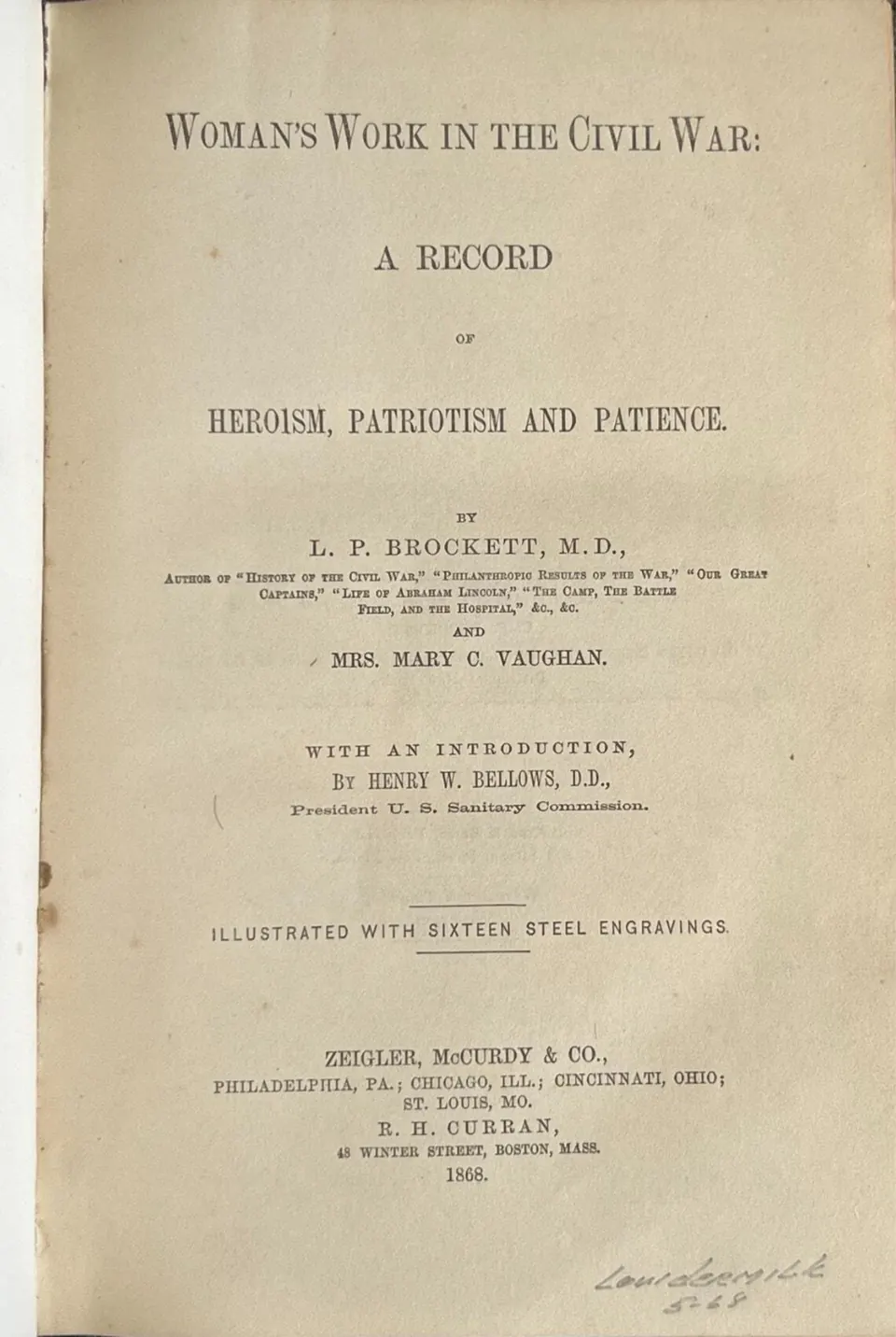
The binding is purple cloth with gold lettering on the spine, which names only "L. P. Brockett." Vaughan is left off the outside. The back cover carries the publisher's shield, blind-stamped with "Z. McC & Co." Somebody penciled a note in the corner of the title page that ends "5-68." It might be a May 1868 date. A few pencil marks leave a lot of room for guessing.
The photos show the engraved title and the Barton frontispiece. I haven't seen the other plates, so I can't say all sixteen are there. That matters, because engraved portraits were sometimes cut out of books like this one.
In What's It Worth?, I'd photograph the title page and its reverse, then the plates one by one, and ask in Dive Deeper what separates the 1867 and 1868 printings and whether all sixteen engravings should be there. Then I'd turn to page 284 and read the apology again.
Sources and Notes
- Object evidence: listing photographs of this copy, showing the 1868 title page, the 1867 copyright and printers' notice on its reverse, the Clara Barton frontispiece and engraved title, the dedication, contents and preface, the spine and the covers. The other plates are not shown.
- L. P. Brockett and Mary C. Vaughan, Woman's Work in the Civil War (Zeigler, McCurdy & Co., 1867), Project Gutenberg text: title page, the sixteen engravings, the Cornelia Hancock chapter (pp. 284–286) with John Vassar's account, and her mentions in the chapters on Mary W. Lee and the relief societies.
- National Park Service, Gettysburg National Military Park, "Cornelia Hancock": her letters on the surgeons, the wine, blood, and writing to wives; the journal line on age; Camp Letterman, City Point, and her school in South Carolina.
- New Jersey Monthly, "Gettysburg's Angel": the July 7, 1863 letter to her cousin, "not another woman within a half mile," the August letter to her mother, Dix's rules, the school at Mount Pleasant, and the packet marked "Burn without reading."
- Wikipedia, Cornelia Hancock, citing Notable American Women, 1607–1950: birth at Hancock's Bridge, family, the Dix episode, the Children's Aid Society, the Army nurses' association, retirement and burial. Sources disagree on the year of her death, so it is not stated here.
- Her letters were published as South After Gettysburg and later as Letters of a Civil War Nurse: Cornelia Hancock, 1863–1865, edited by Henrietta Stratton Jaquette.