
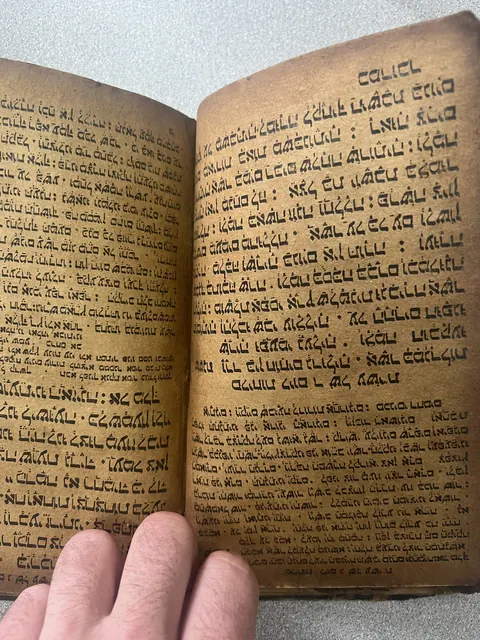
Five dollars, at an estate sale in Madison Heights, Michigan.
The house was somebody's library before it was an estate sale. Theology in quantity. Language-learning books, the kind you buy because you intend to work through them rather than because they look good on a shelf. Several volumes stamped Sacred Heart Seminary.
Most estate sales are an accumulation. This one read like a syllabus.
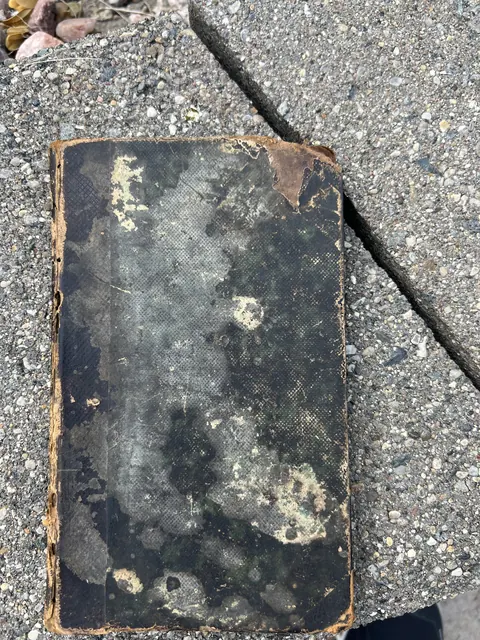
And in among all that, a small brown book with a cover like a weathered roof tile, handwritten right to left in a script nobody standing in that garage could name.
Before the app, the working theory was the Book of Enoch. That guess did not come from nowhere; a chatbot had nudged it that way, and it is the kind of answer that sounds thrilling and costs you a week. Enoch survives mainly in Ge'ez, the liturgical language of Ethiopia. Different alphabet, different continent, different church.
The book is the reason the app got downloaded in the first place. So it is worth saying plainly what happened next, because it is not the story I told in the first version of this article.
The app knew what it was, and then asked for more
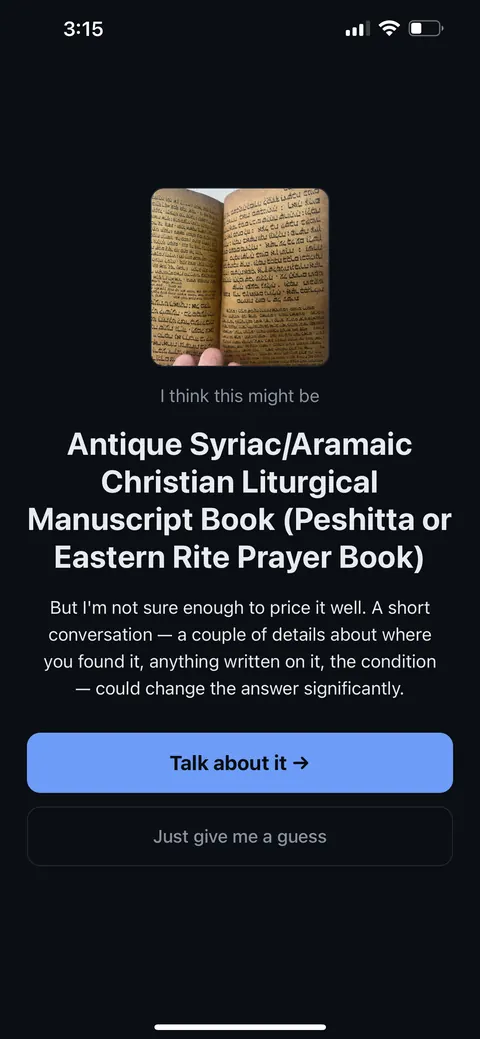
It came back with Antique Syriac/Aramaic Christian Liturgical Manuscript Book (Peshitta or Eastern Rite Prayer Book), and it held that line every time it was asked again. Syriac Christian liturgy. Not Enoch, not Ethiopian, not Hebrew.
That is the correction, and it went in the direction people do not expect. The confident wrong answer came from a conversation. The right one came from pointing a camera at the object.
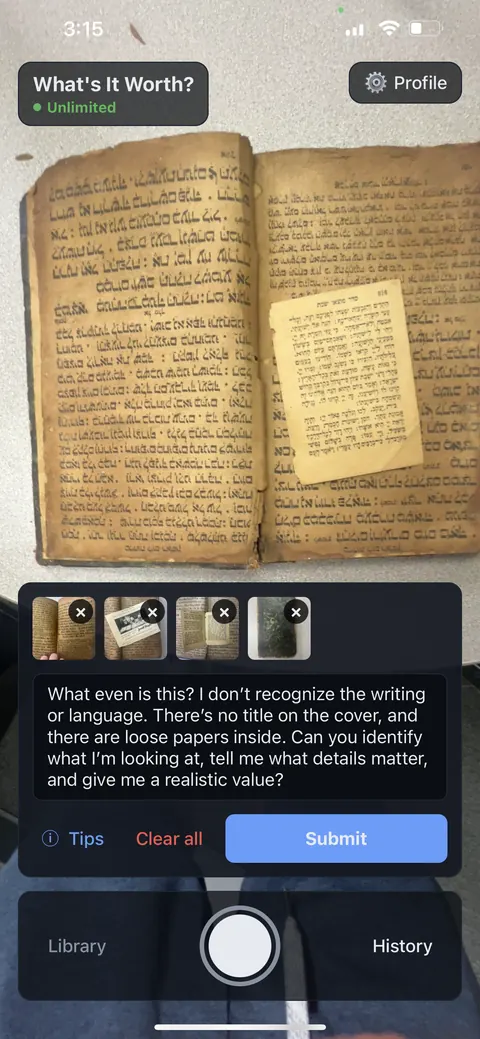
Then it did the useful thing. It did not hand over a number and walk away. It said the price would move a lot with a little more, named exactly what it wanted (where it was found, anything written on it, the condition) and put two buttons underneath: Talk about it. Or Just give me a guess.
That is not a tool refusing. That is a tool saying I can get you there, keep going, give me more, which is what a person who actually knows something says when you show them a photograph.
So the conversation kept going, and with more detail it landed on a likely value of around $270, with the caveat attached rather than buried: that figure moves significantly the moment the identification gets sharper. It also flagged the loose Hebrew pages as their own separate thread worth chasing, which turned out to be the best advice in the whole exchange.
The second button is still the honest part. You can have the fast number if you insist, and nothing pretends it is the same thing as an answer.
I should be straight about where I was standing at this point, because the rest of this article reads like someone who knew what he was looking at and I did not. I could not have told you that Syriac and Hebrew are different scripts. I had never heard of an East Syriac pointing system. Every fact below this line is something I went and found after the app handed over three words: Syriac, Peshitta, Eastern Rite.
It is Syriac, and the dots tell you which kind
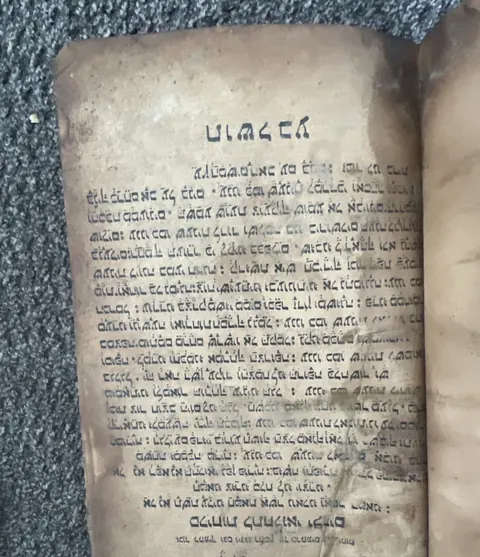
Go in close and the question settles itself. The letters are joined, running along a baseline in connected groups. Hebrew square script does not do that; every letter stands alone. There are tall ascenders rising clear of the line, pairs of dots sitting over words, single dots above and below individual letters, and clusters of dots closing each clause.
Those dots are not decoration and they are not all doing the same job. A pair over a word is syame, the plural marker. The ones above and below letters are vowels, and the way they are made is the actual fingerprint, because it is the East Syriac pointing system rather than the Greek-derived signs the western tradition uses.
East Syriac. The script also goes by Madnhaya, and by Nestorian, and by one other name that matters enormously once you know where the book was found.
It is also called Chaldean.
The pages on top are a different religion
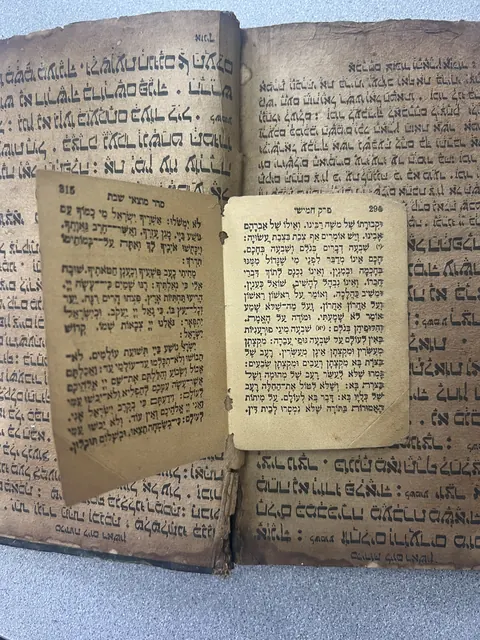
Tucked inside were loose leaves from a completely different book. They are printed, not written. Square Hebrew type carrying nikkud, the vowel points, which turn up wherever a text is meant to be read aloud correctly. They carry their own page numbers, from a volume nobody has.
On a closer look the leaves are not generic Hebrew filler, and this is the upgrade that came out of the second round of investigation.
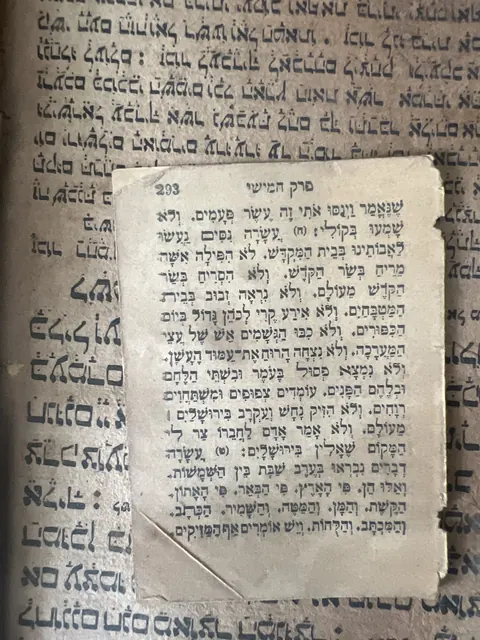
It is Pirkei Avot, and it does not need inferring: the running head at the top of the leaf reads פרק חמישי, Chapter Five, above page 293. Chapters of the Fathers, a tractate of the Mishnah, widely read and widely quoted, bound into prayer books because people sit with it on Sabbath afternoons. Not narrative, not law. Ethical maxims.
The visible text runs through the fourth, fifth and sixth teachings of that chapter, and chapter five is the counting one: ten utterances of creation, ten generations from Adam to Noah, ten miracles in the Temple, ten things made at dusk on the eve of the first Sabbath.
Somebody folded that into a book of Christian liturgy and left it there.
Worth being exact, because it would be easy and wrong to blur it: the hand-written book is not a Jewish book. It is Christian liturgy. Syriac and Hebrew are cousins, both Semitic, close enough that an untrained eye files them in one drawer, and that shared root is part of what makes this shelf interesting. But the book and the thing inside it come from two different traditions, and someone put one inside the other on purpose.
That is the point where I stopped caring what the book was worth. Two faiths, one binding, one owner, and a bookmark that somebody chose. Who keeps those together? I had no way to answer it yet and could not stop turning it over.
Madison Heights is not a random place for this to turn up
Madison Heights sits in Oakland County, an inner-ring suburb about twelve miles north of downtown Detroit, twenty-eight thousand people, the kind of place nobody writes articles about.
It is also inside the largest Chaldean community on earth outside Iraq. More than 187,000 Chaldeans live in southeast Michigan, concentrated in Oakland and Macomb counties, and Madison Heights is named routinely alongside Warren and Sterling Heights as where families settle. The Chaldean Catholic Eparchy of St. Thomas the Apostle has its seat in Southfield, twenty minutes west.
The Chaldean Catholic Church is in full communion with Rome, which is the piece that makes the whole shelf click. It reads Scripture in the Peshitta. It celebrates the East Syriac Rite. Its liturgical language is classical Syriac, written in the script in the photographs above.
And the books around it were stamped Sacred Heart Seminary. Sacred Heart Major Seminary sits on Chicago Boulevard in Detroit, and the Chaldean diocese states it plainly on its own website:
So: a Catholic seminary library stamp, an East Syriac liturgical book, and a suburb at the centre of American Chaldean life, all on one folding table. None of that is proof about any one person. All of it is the same weather.
Now add it up the way it accumulated on me. Liturgy in classical Syriac. A chapter of the Mishnah in Hebrew, kept inside it. Grammars and primers bought to be ground through. Theology by the yard. Seminary stamps on the spines.
That is not a collection. That is somebody's project. And the project is a far better question than the book, which is where the rest of this is going.
The third thing in the box is not scripture at all
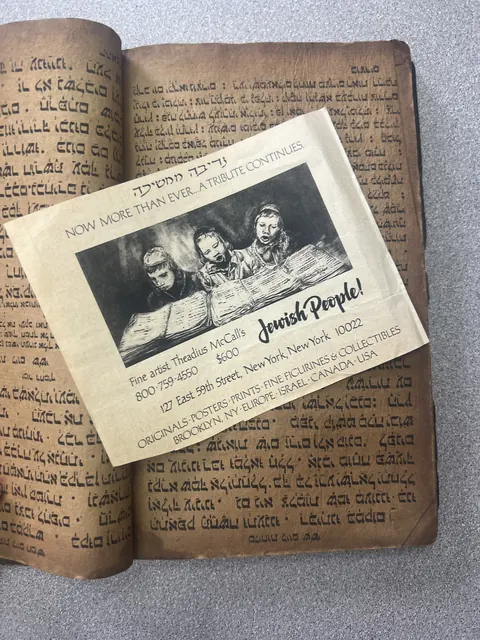
Stored with the rest was a printed advertisement. An engraving of three children bent over an enormous open book. The headline: “Jewish People!” Above it, NOW MORE THAN EVER…A TRIBUTE CONTINUES. Below it, a Manhattan address at 127 East 59th Street, a toll-free number, and a price: $600.
The artist is named on the sheet. Theadius McCall.
That is a real person and the name opens a door. McCall was a self-taught Black artist who grew up in Williamsburg, Brooklyn, among his Jewish neighbours, and never took a class or worked with an agent. His subjects were sharecroppers and old farmers, and then, later, rabbis and yeshiva students. The series this advertisement belongs to is called A Tribute to the Jewish People, and it is exactly what the title says: an outsider paying attention on purpose, for years, to a tradition that was not his.
So the third thing in this box is not a third faith. It is a dealer's flyer for a painting, which makes it the only item here with no religious claim on anybody. And it is the one that rhymes hardest with the rest, because it is another man from outside a tradition who spent years looking at it closely, on purpose, and made something out of what he saw.
A Black artist in Brooklyn paying attention to his Jewish neighbours for a working lifetime. Whoever owned this shelf, doing something recognisably similar with a grammar book and a lamp. I am not going to pretend that is proof of anything. But somebody clipped that advertisement and kept it, and people keep the things that describe them.
What kind of person builds this shelf?
This is the part I keep coming back to, and it is why the book stopped being the interesting object about an hour into the work.
The book is evidence. The shelf is the find.
Somebody assembled this on purpose: liturgy in classical Syriac, a chapter of the Mishnah kept loose inside it, grammars and language primers bought with the obvious intention of grinding through them, theology by the yard, seminary stamps, and an advertisement for a Black artist's tribute to Jewish tradition, clipped and kept. That is not a decorative shelf. Nobody buys language primers for a shelf. You buy those because you have decided the translation is not close enough and you want to meet the thing in the language it was written in.
Priest, seminarian, monk, scholar, or simply a man who could not leave it alone. Nothing in the material names him and I am not going to invent him. But whoever he was, he was in deep, and he was going somewhere.
Here is where I want to push. Everything from this point on is thinking rather than knowing, and I will keep saying so.
There are two lazy readings and I want to get them out of the way. The warm one: a man with an open heart admiring a neighbouring faith. The suspicious one: a man reading his way out of his own tradition, quietly losing his nerve. The first is sentimental, the second is a novel, and I think both are less likely and far less interesting than what the shelf actually suggests.
Here is the reading I would defend.
Christianity came out of Second Temple Judaism, and the two have been arguing ever since. Two thousand years of it, much of it conducted by clergy, in the original languages, deliberately. And rabbinic literature is itself built out of argument: the minority opinion preserved on the page beside the ruling that beat it, the objection kept rather than tidied away. Disputation is not an embarrassment in either tradition. It is the native form. This is not a scandal that needs softening. It is what taking a question seriously has always looked like.
So a Christian teaching himself Hebrew is not a man wavering. He may be a man who has taken the disagreement seriously enough to want to get it right, and who has noticed that you cannot honestly argue with a tradition you know only through your own tradition's summary of it. Learn the Hebrew and you stop arguing with a description of Judaism. You start arguing with Judaism.
And the Syriac runs the other way. Not across, but back. Past the English, past the commentary, toward the language-world his own faith actually came out of. Syriac is a dialect of the Aramaic Jesus spoke. The Peshitta is one of the oldest continuously used scriptural traditions there is.
Put those two beside each other and they stop looking like two different impulses. They are one impulse pointed in two directions. Stop trusting the summary. Go to the source. One road runs back toward where his faith came from. The other runs across to the tradition it came out of. A man walking both is not leaving. He is going further in.
Which raises a question I did not expect to be interesting: was any of this straightforward to do?
Both traditions have, at different points, put guardrails around outsiders handling their texts. On the Jewish side that conversation is ancient, internal, and heavily qualified by later authorities, and it is not the one that bears on a man with seminary books on his shelf. The one that does is his own Church's.
For four centuries Rome kept a list of books Catholics were not to read without permission, and Hebrew and rabbinic works were on it. That is not obscure history. The final edition of the Index Librorum Prohibitorum was published in 1948, and it kept the force of ecclesiastical law until the Congregation for the Doctrine of the Faith withdrew it on 14 June 1966.
Eight months before that, on 28 October 1965, the same Church promulgated Nostra Aetate, which repudiated the charge of collective Jewish guilt for the death of Christ, condemned antisemitism, and told Catholics to pursue exactly the kind of study and dialogue this shelf looks like.
If it was assembled before 1966, then a Catholic sitting down with rabbinic material was doing something his own institution had spent centuries treating with caution, and he would have known that. Not forbidden to a cleric who asked, but not casual either, and not a thing you did without having decided it mattered.
If it was assembled after, he was among the people who took the Council at its word immediately and started doing the reading rather than admiring the document.
Careful over-corrective before anyone runs with this: I do not know that he was Catholic, only that Catholic seminary books were on his shelves, which makes it the obvious guess and not a fact. Nor do I know when any of it was bought. What I am confident of is that on either side of 1966 this represents a decision, not a drift. Nobody learns two dead liturgical languages by accident.
And then there is what the bookmark actually says.
The running head on that leaf reads Chapter Five, and chapter five is the counting chapter. The world spoken into being with ten utterances. Ten generations from Adam to Noah, ten more from Noah to Abraham. Ten miracles in the Temple. Ten things created at dusk on the eve of the first Sabbath, in the last of the light, before rest. It is a sustained argument that history has a deliberate shape and that the shape can be read by anyone willing to count.
A man keeping that page inside a book of Christian liturgy written in Aramaic is not collecting curiosities. He is holding two traditions that both insist the order of things is legible, each in the language it makes the claim in.
I do not know which of these he was. I suspect a real person does not sort cleanly, and that on different evenings he was all of them: the admirer, the disputant, the man hunting the source.
But I will say the thing I actually think, and I will label it as thinking. Underneath the languages and the grammars and the theology by the yard sits the least academic question there is.
That is not a strange way to spend a portion of a life. It might be the only unarguably good reason to spend one. The strange part, the part I keep turning over, is that it ended on a folding table in a garage in Madison Heights, priced at five dollars, because nobody in the room could read the cover.
So what is it worth?
Around $270, on the evidence available, and that number is genuinely provisional rather than politely provisional.
Books in unfamiliar scripts carry one of the widest value ranges you will meet at an estate sale, and the range is not driven by how old the thing looks. A common nineteenth or twentieth-century devotional manuscript in poor condition sits near the bottom of it. A dated, located, identified manuscript with a colophon is a different object with different buyers and a different decimal point. They sit in the same box and look identical to somebody in a hurry.
Four questions collapse that range, and not one of them can be answered from a phone photograph taken at arm's length:
- Manuscript or lithograph? Nineteenth-century lithographic reproduction of handwriting fools people constantly. Handwriting drifts. Printing does not. This needs magnification, not megapixels.
- Is there a colophon? Syriac manuscripts often name their scribe, their place and their year at the end of the block. Its absence is information too.
- How old, actually? Browning says bad storage, not a date. Paper, ink and binding have to be looked at in person.
- What work is it? A breviary, a Peshitta portion, a specific office. The headings are right there on the page and a reader settles it in minutes.
The Hebrew leaves are their own question and may carry their own value, which the app spotted before anybody else did. And the advertisement is asking $600 for a McCall print, which is not what a clipped advertisement is worth, but it does tell you what the thing it advertises was priced at.
At five dollars, none of this was ever really about resale. The book was asking a question worth the trouble of answering, and the question turned out not to be about the book.
This is not finished, and that is not a figure of speech
Everything above came from four photographs and one conversation, then a second round of photographs that produced a named tractate and a page number the first round had missed. Each pass made the object less mysterious and the person behind it more interesting. That is the actual shape of this work, and it is why the ending is not an ending.
Here is what happens next, and it is real rather than a cliffhanger.
We are going to get this read by someone who reads it. Not a script identification, which we now have, but the work itself: which office, which rite, which century, what the headings actually say. There is a path through people we know to the Chaldean church in Detroit, and metro Detroit holds more readers of this script than almost anywhere outside Iraq. The plan is to sit with the book open, go through the pages with the app running alongside a person who has read this language since childhood, and find out how much of the last two thousand words was right.
Which is a slightly uncomfortable thing to commit to in public. Good. That is the only kind of promise worth printing.
Four cheap things would move it before that even happens:
- The headings. The rubric at the top of the page above is the book naming its own contents. Two or three flat, well-lit shots of those is the highest-value photograph anybody can take next.
- The last leaf. If a colophon survives at the end of the block it may carry a scribe, a place and a year, and that turns an object into a record.
- Manuscript or lithograph. Magnification, not megapixels. Until that is settled, even the word manuscript in this article is doing more work than it has earned.
- The seminary stamps. The Sacred Heart volumes from the same sale may carry accession numbers or a donor plate, which is the closest thing to a name anyone is likely to get.
And if you read Syriac, or you know how the seminary's library was dispersed, or you recognise the prayer book those Hebrew leaves were torn from, Support reaches us and I would genuinely rather be corrected than admired.
A man spent years of evenings trying to get closer to something true, in three languages, and it ended in a garage for five dollars. The least we can do is finish reading it.