
I braced before I lifted it. An unabridged dictionary is supposed to be a two-handed object, the kind of book that lives on a stand because nobody wants to carry it twice. This one is a Webster's New International Dictionary, sold as a 1924 copy, and it came up off the table too easily, like a suitcase somebody had already unpacked.
Then I opened it, and the page moved like tissue. I turned the next one very carefully, the way you turn a page in a Bible that belonged to somebody's grandmother.
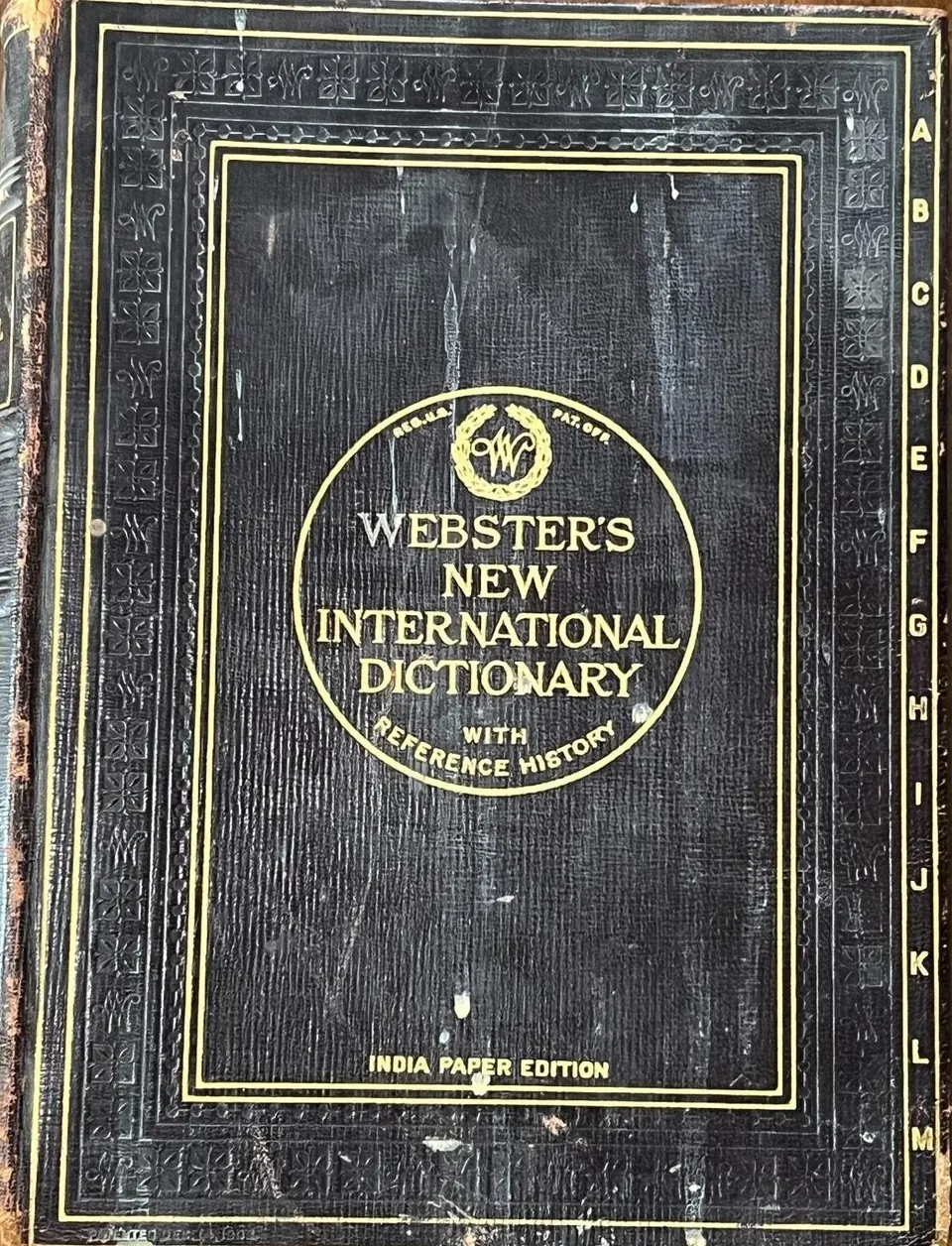
The cover had already told me why. Inside the circular trademark it says Webster's New International Dictionary with Reference History, and along the bottom, in small gold capitals: India Paper Edition. I had always taken "India paper" for a phrase from book dealers. I started to wonder why anyone would print a dictionary on paper made for Bibles.
Paper Made for Bibles
India paper is very thin, very strong and surprisingly opaque for how thin it is. The name came from fine thin paper brought to England from Asia, and Oxford University Press spent decades trying to match it. The Museum of Oxford describes the Press's pursuit of ever thinner paper and ever smaller books as an obsession. Its own version, Oxford India paper, was first made at the Wolvercote Mill in 1875.
Its first big job was the Bible. A Bible is long, people want to carry it, and nobody wants a church pew to sag. On India paper, Oxford says, you could get about 1,000 pages into an inch. The whole thing fit in a book small enough to carry, and those Bibles traveled widely with missionaries.
Dictionaries have the same problem as Bibles, only worse.
The Biggest Book in the House
In 1909 the G. & C. Merriam Company of Springfield, Massachusetts, published a completely revised unabridged dictionary and called it Webster's New International Dictionary of the English Language. The editor in chief was William Torrey Harris, a former superintendent of the St. Louis schools, with F. Sturges Allen as general editor.
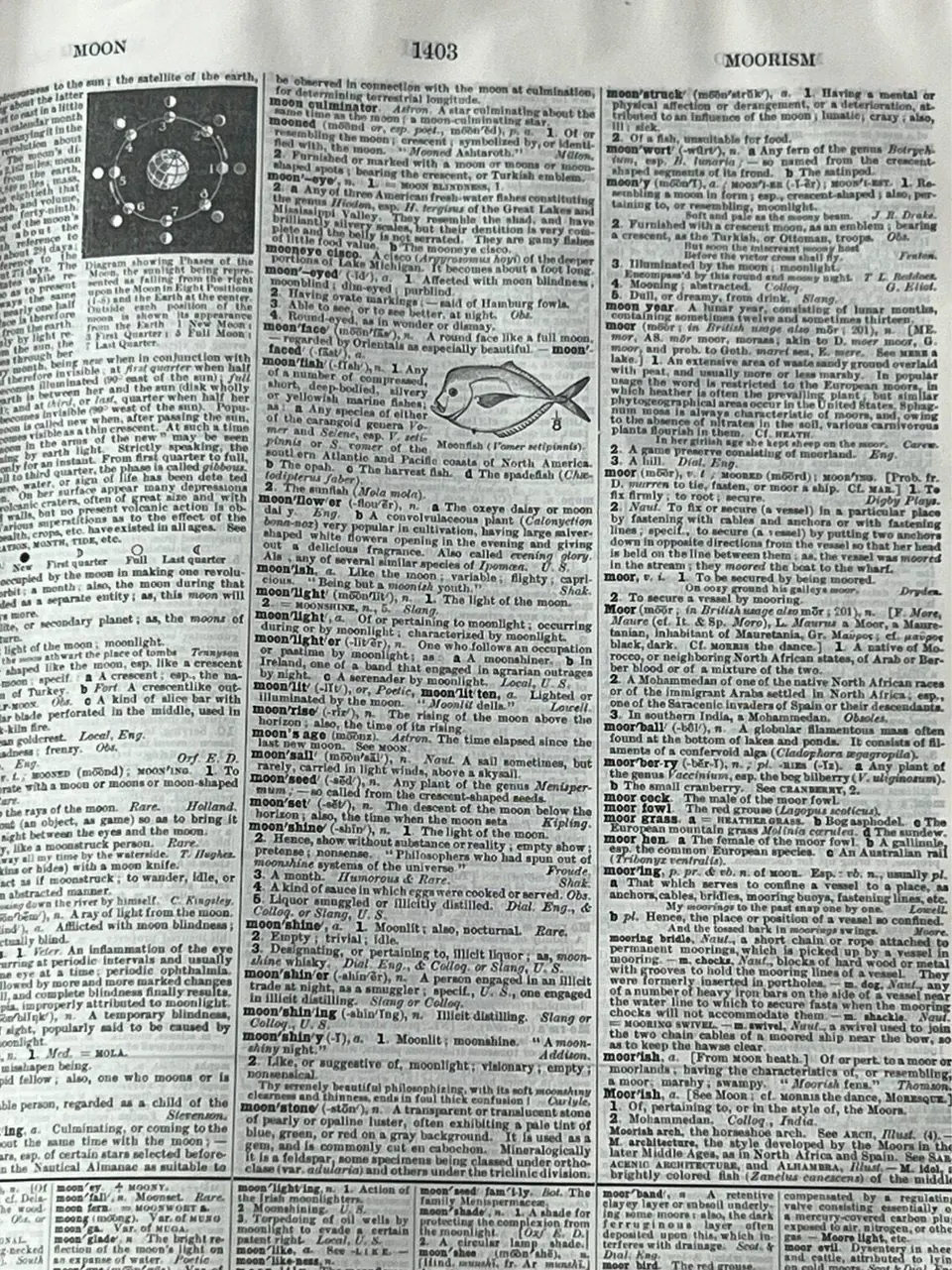
Harris solved one size problem with a design trick called the divided page. Common words ran across the top of each page at full size. Rare and obsolete words went to the bottom in smaller type, so the dictionary could carry far more words without getting twice as big. Open this copy to page 1403, between moon and Moorism, and there it is: a band of finer type running along the foot of the page.
It was still huge. A 1922 Merriam advertisement counted 400,000 vocabulary terms, 2,700 pages, 6,000 illustrations, 30,000 geographical subjects and 12,000 biographical entries. That ad ran in a high school student magazine in Albemarle, North Carolina, telling teenagers that "the one who knows wins success." At the bottom, in small type, it offered two versions: "Regular and India-Paper Editions."
Light Enough to Lift
The India-paper edition was Merriam's answer to the other size problem, the one you notice when you try to pick up the book.
Merriam was advertising the lighter edition by the 1910s. A 1912 ad in The Saturday Evening Post put the India-paper edition at 7 pounds. As the Post itself observed in a look back at its old dictionary ads, the picture makes the point that it was so light even a woman could lift it. A century later that ad is funny for the wrong reason. It is also honest about who Merriam thought was going to be carrying the dictionary to the kitchen table.
I think this is the part that got me. Everything about the India-paper edition is aimed at use. A dictionary you can't get down from the shelf is a reference book in theory only. Somebody at Merriam decided that the best dictionary in the house should also be the one people actually open, and the way to do that was the kind of paper Oxford had made famous with the Bible. Whose mill actually made Merriam's sheets is a question I haven't been able to answer yet. Nothing I found says it was Oxford's.
A Hotel Map in the C's
Somebody else used this copy before me, and they left a bookmark. Folded in at pages 428 and 429, between cockatoo bush and cocksfoot, is a printed street map for the Hotel Harris, "Mass. Ave at N. Capitol, Washington D.C." Across the top it promises "Centrally Located," "Moderate Rates" and a "Homelike Atmosphere." A red arrow points at a black square a few blocks from Union Station.
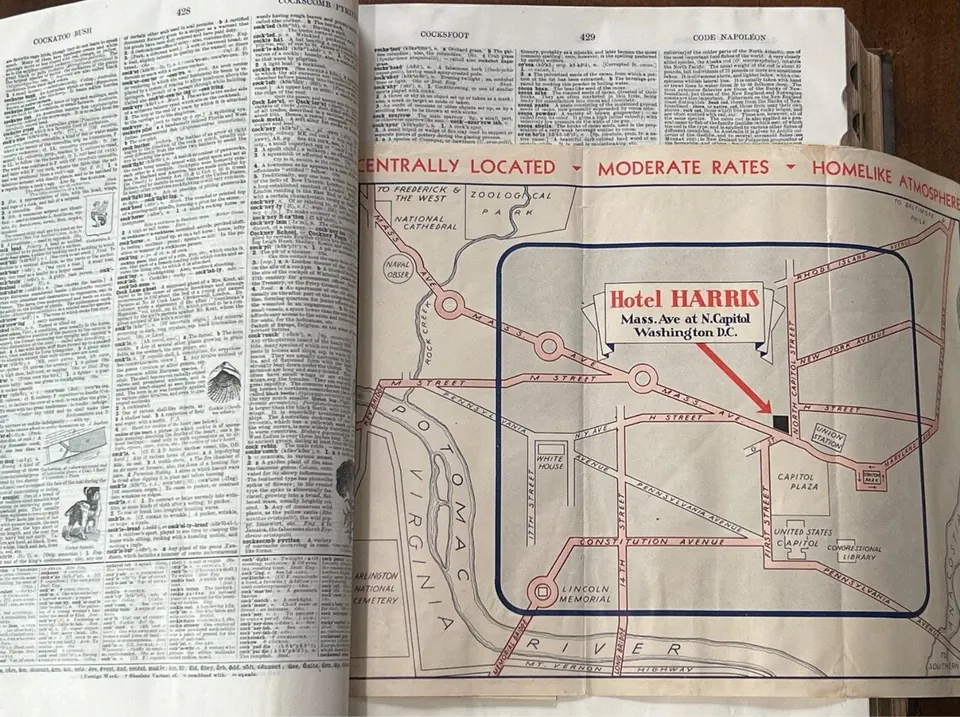
I couldn't find anything about the Hotel Harris itself. The map turned out to be easier to date. Running across the bottom, past the Lincoln Memorial, is Constitution Avenue. Congress gave B Street that name in February 1931. That gives me an earliest likely date for the map and leaves me wondering who slipped it into the book.
I like the idea of a dictionary that went along on the trip, or at least came home to the person who took it. The book was made light enough to move around. Somebody took it at its word.
Look for the Name on the Title Page
There was another reason Merriam's ads talked so much about what was inside the cover. In 1908 a federal appeals court ruled that the name "Webster" had passed into the public domain. Anyone could put Webster on a dictionary, and plenty of publishers did.
So Merriam taught its buyers to check. Its ads warned against "so-called Webster dictionaries" and told readers to look for "the circular trade-mark" and the name MERRIAM "on the title-page." This copy has both marks where I can see them. The circular trademark is on the front cover, and the spine reads "Latest Authentic Edition of the Merriam Series with Reference History," with G. & C. Merriam Co. at the foot. Inside, a steel engraving of Noah Webster with his signature faces the front of the book.
Dating This Copy
This is where I have to stop short. The New International was reprinted many times between 1909 and the second edition of 1934, and Merriam updated it along the way. The listing says 1924. The photos I have show the cover, the spine, the colored plates, the contents page and a few text pages, but not the title page or the copyright dates on its reverse, and those are what settle a printing. The copyright line under each colored plate is too small to read in the photos. So for now 1924 is the listing's date, not one I can confirm.
Here is what the photos do settle. It is the India Paper Edition, and it is the version with the Reference History, which the contents page places after page 2620. The pages are thin enough to show their age in a lot of tiny creases, and the marbled endpapers have a couple of small tears.
In What's It Worth?, I'd photograph the title page and its reverse, then ask in Dive Deeper which printing those copyright dates point to. I'd give the map a photo of its own. Whoever tucked it in left me another little mystery, and all I was doing was looking up a word.
In the meantime, I've started looking words up in it. It is the first dictionary I've owned that I don't mind carrying across the room.
Sources and Notes
- Object evidence: listing photographs of this copy, showing the India Paper Edition cover with the circular trademark and thumb index, the Merriam spine, the Noah Webster frontispiece, colored plates, the contents page, pages 428–429 with the Hotel Harris map, and page 1403. The title page and its reverse are not among the photos, so the printing year is unconfirmed.
- Museum of Oxford, "A Global Trade": Oxford University Press's pursuit of thinner paper, Oxford India paper first made at Wolvercote Mill in 1875, and its use for compact Bibles.
- Oxford University Press blog, "Eight fun facts about Bibles at OUP": Oxford India paper and about 1,000 pages per inch.
- Grolier Club, Webster's New International Dictionary: William Torrey Harris and the divided page.
- G. & C. Merriam Co. advertisement, The Midget (Albemarle High School), May 1922: vocabulary, page and illustration counts, and "Regular and India-Paper Editions."
- The Saturday Evening Post, "Vintage Dictionary Advertisements": the 1909 revision, the 1912 India-paper ad and its 7 pounds, the 1908 court ruling on the Webster name, and Merriam's title-page warning.
- Congress renamed B Street North in February 1931. U.S. Statutes at Large, volume 46, page 1420 (PDF)